

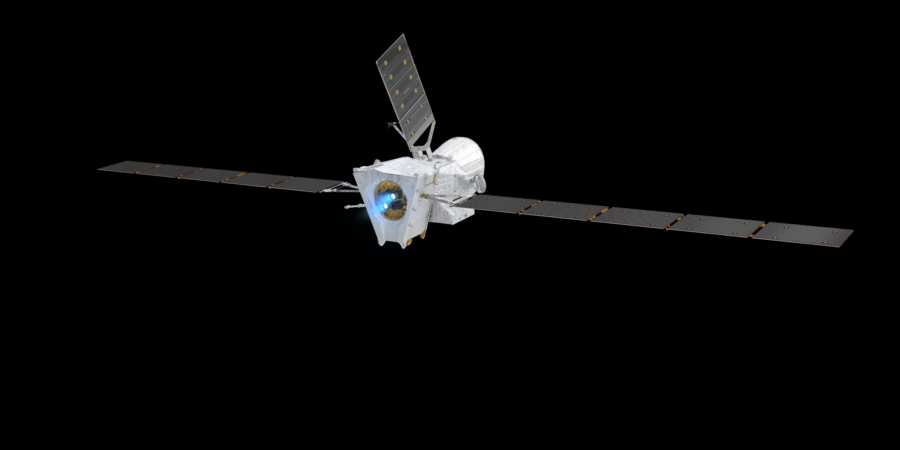
The BepiColombo mission, en route to Mercury, has just achieved a critical milestone: the successful separation of the two modules, MPO (ESA) and MMO (JAXA), from the main spacecraft on September 3, 2026. This maneuver marks the beginning of the mission’s final phase, before the spacecraft enters Mercury’s orbit on November 21, 2026. It will reach its final orbit on March 10, 2027, and is expected to observe Mercury’s surface for approximately one year.
The mission aims to understand the formation and evolution of rocky planets, particularly those located very close to their star, as well as the interactions between the solar wind and the magnetosphere and the extreme thermal conditions on Mercury’s surface.
Mercury is a mysterious and extreme planet: its proximity to the Sun makes it a unique object of study.
LAM’s Role in the Mission
The Laboratoire d’Astrophysique de Marseille (LAM) is actively contributing to this ambitious mission, particularly through:
- Data processing: Calibration and contribution to the processing of images from the SIMBIO-SYS camera, a key instrument for studying Mercury’s surface and environment.
- Scientific interpretation: Analysis of data from the MERTIS (infrared spectrograph) and SIMBIO-SYSinstruments.
This work will help better understand the composition, geology, and evolution of the planet closest to the Sun.
BepiColombo, a collaboration between ESA and JAXA, is the first European mission to explore Mercury. It will provide unprecedented data to uncover the secrets of this little-known planet.
For More Information
- Mission description: Official website
- Follow mission updates: Cité de l’Espace website