

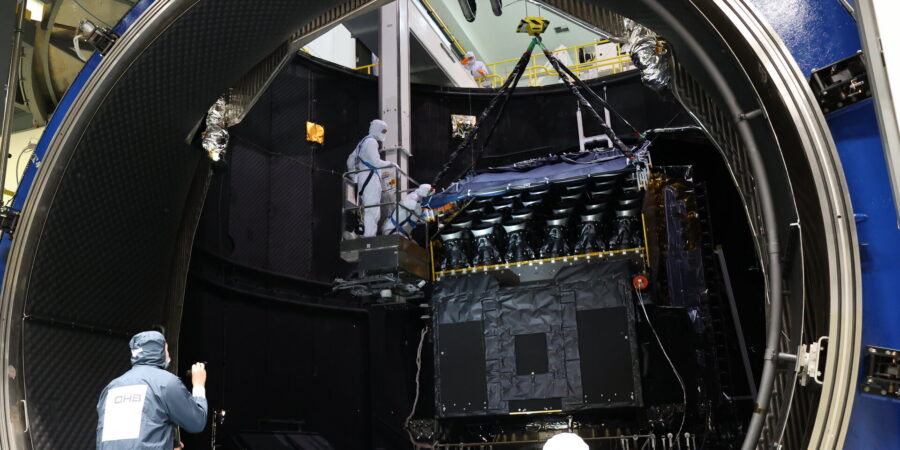
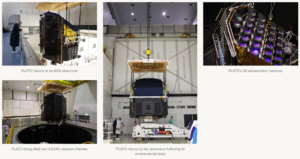
PLATO emerges from the ESA vacuum chamber
The PLATO satellite has successfully completed its space environment simulation tests. With this key milestone achieved, the satellite is now ready to enter its final phase of preparation ahead of its launch in early 2027, with the aim of discovering new exoplanets and stellar characterisation.
PLATO has just emerged from ESA’s Large Space Simulator, Europe’s largest vacuum chamber, where engineers have tested its ability to withstand the conditions it will face in space, tests which it passed successfully. For any space mission, ‘testing under representative conditions’ is essential. Before launching any instrument, it is essential to verify all its functions under the same conditions as those it will encounter in orbit. PLATO has just passed these tests successfully!
How are these tests carried out?
Once the vacuum chamber doors were sealed in early March, powerful pumps extracted the air from the chamber, creating a vacuum nearly a billion times sparser than Earth’s atmospheric pressure. At the same time, liquid nitrogen was pumped through the walls to replicate the intense cold of space. In addition, a network of heating elements was activated to mimic the heat of the Sun striking PLATO’s solar panels and heat shield.
Watch the video of PLATO entering the vacuum chamber.
The crucial test for PLATO: that of its 26 ultra-sensitive cameras
PLATO’s main objective is to detect Earth-like exoplanets orbiting bright stars similar to the Sun. To achieve this, the performance of PLATO’s 26 ultra-sensitive cameras is essential.
These cameras must measure small variations in brightness during planetary transits. The required precision is extreme: the aim is to detect decreases in brightness of just a few fractions of a per cent. The tests carried out in the vacuum chamber have therefore confirmed that the team can control the cameras and the rest of the satellite’s systems to the standard required to detect small planets.
Specific tests were carried out to evaluate the cameras, particularly their sharpness and focus, which is fine-tuned by adjusting the temperature of their optical tubes. The engineers therefore conducted a series of tests to verify that it was possible to maintain the cameras’ optimal focus by controlling their temperatures with a very high degree of precision.
Hot and cold environment testing
The entire PLATO satellite was then subjected to conditions even more extreme than those expected in orbit, in order to test its performance under both nominal space conditions and adverse conditions.
During the hot phase, all the satellite’s systems were run at full power, whilst the side with the solar panels heated up to 150°C. At the same time, the cameras, facing the cold zone and protected by the heat shield, were kept between -70 and -90°C.
During the cold phase, the temperature was lowered across the entire satellite. The heaters had to be switched on to prevent the cameras from becoming too cold, thereby ensuring they continued to function properly.
What happens next ?
Although the tests in an environment simulating space conditions are now complete, the analysis of the data collected during these tests will continue over the coming months. Engineers and scientists will study the data in detail to gain a better understanding of the satellite’s behaviour and the detailed performance of its instruments.
These results will enable the refinement of thermal and instrumental models, which will be essential for predicting in detail how the cameras will react once PLATO is in flight, in early 2027.
PLATO at LAM
At LAM, a team of 20 people is working on the ground-based monitoring database, the exoplanet analysis pipeline, the algorithm for classifying planet candidates, and data analysis tools. The team is involved in PLATO Science Management, the PLATO Data Centre, the Mission Steering Committee, and Performance Support. The team is led by Magali Deleuil (Scientific Lead) and Chrystel Moreau (LAM Project Manager), who are actively involved in the preparation of the PLATO mission.
Source : https://www.esa.int/Science_Exploration/Space_Science/Plato/Plato_aces_space-like_tests