

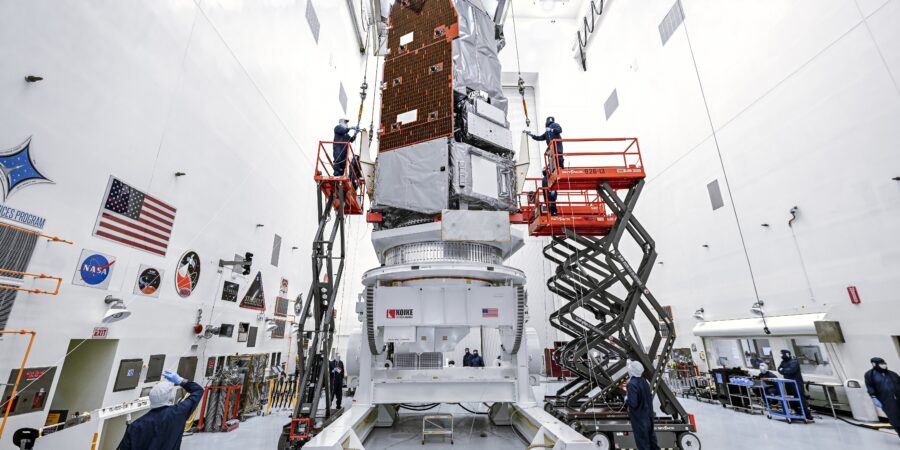
Integration of Roman at NASA’s Goddard Space Flight Center / NASA / © NASA
This Sunday, August 30, 2026, the Nancy Grace Roman Space Telescope was successfully launched from Florida aboard a Falcon Heavy rocket, marking the beginning of a mission that promises to revolutionize our understanding of the Universe. France, represented by the Centre National d’Études Spatiales (CNES), the Laboratoire d’Astrophysique de Marseille (LAM), the CNRS, and its Institut National des Sciences de l’Univers (INSU), plays a key role in this flagship NASA project, making our country one of the essential partners in this historic scientific endeavor.
A mission that will redefine global astrophysics
The Roman Space Telescope is often described as the successor to Hubble, but with 100 times greater capabilities. Thanks to the exceptionally wide field of view of its Wide Field Instrument (WFI), it can observe millions of galaxies in a single image, whereas Hubble could only capture a few thousand. With similar resolution, Roman will study dark energy, the mysterious force that makes up 75% of the Universe and accelerates its expansion. This instrument will also be able to indirectly detect thousands of exoplanets toward the bulge of our galaxy, the Milky Way.
By operating in synergy with the James Webb and Euclid telescopes, Roman will provide an unprecedented and complementary vision of the Universe, covering a broad spectrum of the near-infrared, giving access to the farthest reaches of the cosmos.
Roman’s second instrument is a coronagraphic instrument (CGI) that blocks starlight to reveal otherwise invisible planets. The CGI is a technological demonstrator that, for the first time, will provide images of cold exoplanets similar to Jupiter, reflecting the light of their star. This achievement will help us better understand their composition and formation. This feat is made possible by combining multiple instrumental techniques to achieve performance 1,000 times greater than previous observatories.
France’s role in the Roman mission
France’s participation in the Roman mission is both strategic and innovative.
CNES is responsible for French contributions, for which it signed an agreement with NASA in 2023. It coordinates and funds the contributions of French laboratories, ensuring that France remains at the forefront of space innovation. The main French contribution comes from LAM, which designed and manufactured 16 off-axis parabolic mirrors for the CGI. These components, polished under stress with unparalleled precision, were developed with the support of CNES.
These optics will reveal exoplanets up to a billion times fainter than their star, a technological feat that places France at the forefront of global astrophysics.

Interferometric laser measurement session during the manufacturing of the off-axis parabolas for the coronagraph
© Cyril FRESILLON / LAM / CNRS Images
LAM also contributes its expertise in spectroscopic data processing for the WFI, acquired notably through its involvement in the ESA’s Euclid mission.
Finally, CNRS and INSU actively support the project by mobilizing the best scientific teams to exploit Roman’s data and make it a lever for French research.
A team from CNES and LAM attended the launch in Florida and participated in the preparation of the first observations from the Coronagraph, symbolizing France’s strong and concrete commitment to this mission.
Why is this project so important for French science?
France has historically been a leader in cosmology, with missions like Euclid and Planck led by French teams, as well as in the field of exoplanets and high-contrast observation with instruments like SPHERE at the VLT and the coronagraph on the James Webb Space Telescope. Through their participation in Roman, French research laboratories and CNES will be able to maximize the synergies between Roman, Euclid, and JWST, while gaining unique experience in space coronagraphic instrumentation in preparation for NASA’s next major mission, the Habitable Worlds Observatory.
Quotes
“Roman’s coronagraph opens a new era for exoplanet imaging, achieving performance 100 to 1,000 times greater than what is currently possible from the ground.”
— Arthur Vigan, French representative of CNES for Roman’s CGI.
“The technological demonstration provided by Roman’s Coronagraph is a decisive step toward NASA’s next mission, the Habitable World Observatory, which will aim to study the habitability conditions of Earth-like planets.”
— Elodie Choquet, Deputy Astronomer at LAM.
“The trust placed by NASA in our ability to deliver the ultra-precise optics for Roman’s coronagraph reflects the recognition of our expertise in this field. We continue to improve our manufacturing processes and have already begun working with NASA on the optics for the coronagraph of the future Habitable Worlds Observatory mission.”
— Marc Ferrari, Astronomer at LAM, responsible for the delivery of the coronagraph’s optics.
“At the technological level, this is the culmination of a decade of research and development in materials science, optics, and process science, which have enabled our participation in this magnificent space adventure.”
— Emmanuel Hugot, Astrophysicist at LAM.
“Roman embodies a technological feat: its cutting-edge instruments, its exceptionally stable telescope for a mass of ten tons, and its extremely high-performance ground processing will provide unparalleled observations. By succeeding in this challenge, it paves the way for future astrophysics and cosmology missions.”
— Isabelle ZENONE, Project Manager of France’s contribution to the Roman project.
“By plunging into the young Universe, just a few billion years old, Roman will open a new path to study the large-scale structuring of matter. Its unprecedented measurements, complementary to current cosmological missions, will be decisive in decoding the greatest secrets of the cosmos, including the nature of dark energy.”
— Sylvain de la Torre, Astrophysicist at LAM.
“Roman is an exceptional mission, both in its scientific ambition and the technological challenges it addresses. For LAM, it is a beautiful demonstration of our ability to go from instrumentation to science, to explore two of the great questions of contemporary astrophysics: the nature of the Universe and that of other worlds.”
— Stéphane Arnouts, Director of the Laboratoire d’Astrophysique de Marseille.
About the French Partners :
- The Laboratoire d’Astrophysique de Marseille (LAM) is a research unit (CNRS / Aix-Marseille Université / CNES) specializing in the study of the Universe, the development of cutting-edge instrumentation, and the analysis of large astrophysical datasets. The laboratory is involved in numerous national and international projects and actively contributes to the dissemination of scientific knowledge.
- The CNRS (Centre National de la Recherche Scientifique) is France’s leading research organization. It supports ambitious projects like Roman to advance science and strengthen France’s position in global research.
- The Institut National des Sciences de l’Univers (INSU) of the CNRS is a pillar of research in the sciences of the Universe. It funds and coordinates major projects like Roman, contributing to pushing the boundaries of knowledge.
- CNES (Centre National d’Études Spatiales) is the French space agency. It coordinates and funds national contributions to major international projects, ensuring that France remains a key player in space exploration.
Watch the launch here.