
Study reveals that two types of primitive meteorites were implanted in the asteroid belt at different times, reshaping our understanding of the Solar System’s origins.
Plain-language summary
- CM and CI meteorites come from different regions of the outer Solar System.
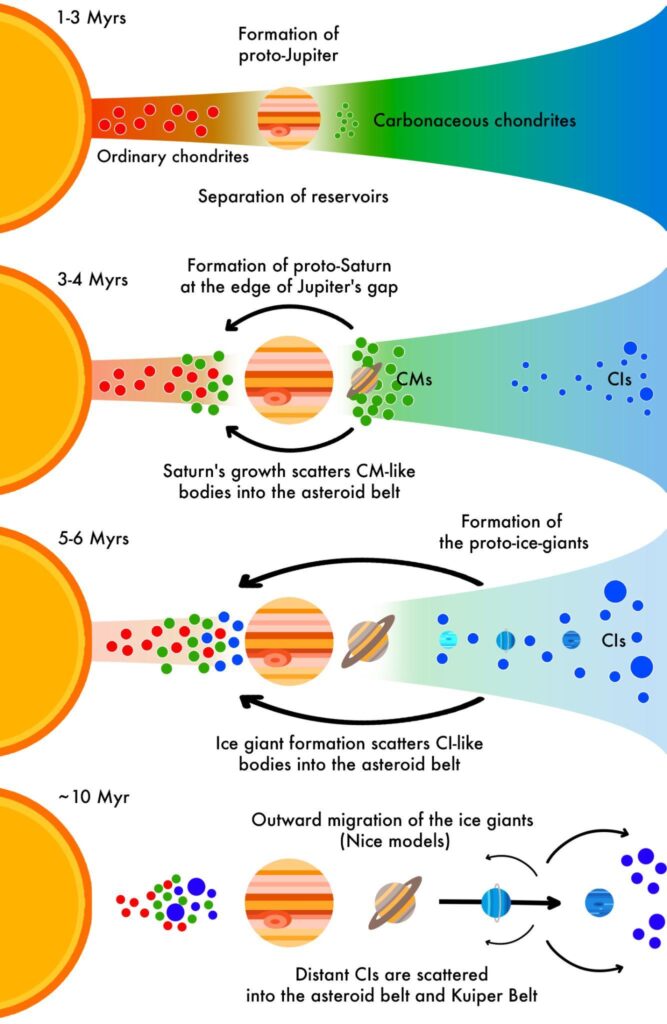
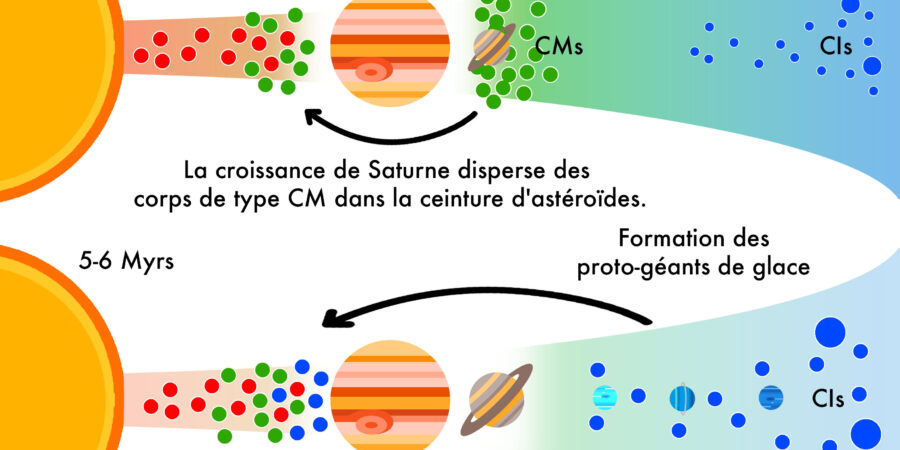
- They were implanted in the asteroid belt at different times: during Saturn’s formation (CMs) and later during Uranus/Neptune migration (CIs).
- This timing difference explains their contrasting compositions and distributions.
- CM-like asteroids likely delivered much of Earth’s water.
Astronomers have uncovered new clues about the birthplace of the Solar System’s oldest and most primitive materials. A recent study published in Nature Astronomy by Sarah E. Anderson (Aix Marseille University), Pierre Vernazza (Aix Marseille University), and Miroslav Brož (Charles University) provides compelling evidence that two major groups of carbonaceous meteorites —known as CM and CI chondrites— originated from asteroids that arrived from beyond Saturn, Uranus, Neptune to the inner Solar System from two distinct locations (~10 AU and >20 AU) at two distinct times: ~3-4 and ~4-5 million years, respectively, after the very formation of the Sun.
Primitive meteorites are usually characterized by the presence of chondrules — tiny, spherical, crystallized parts formed by rapid cooling. While CM chondrites are rich in chondrules, CI chondrites have none. This immediately points to different formation locations of those
meteorites, or to be more precise, of asteroids closely resembling those meteorites, because only sizable, 100-km bodies were able to survive ~4.5 billion years of Solar System evolution.
The astronomers initially noticed that CM-like and CI-like asteroids, observed today in the asteroid belt between Mars and Jupiter, are located at different distances from the Sun. However, this is not their original formation location; it is known that carbonaceous materials formed beyond Jupiter and were implanted in the asteroid belt. The researchers thus performed extensive numerical simulations of this process to determine the specific regions from which these asteroids originated.
“The implantation process is complex,” explains Sarah Anderson, the lead author of this study. “You have to consider not just the planets and their growth and migration, but also the gas-rich environment of the early Solar System. This gas, what we call the solar nebula, creates aerodynamic drag, or friction, which can slow planetesimals scattered from the outer Solar System and help trap them in stable inner orbits.”
The breakthrough came when researchers realized that the distances of implanted planetesimals always `mirrored’ the state of the nebula at the moment when they arrived.
If there was a gas overdensity, for example, at ~3 astronomical units, most planetesimals were captured on stable orbits at that distance. Consequently, the different distances of CM-like and CI-like asteroids observed today point to different arrival times, each corresponding to a unique stage in the nebula’s evolution. CM-like asteroids arrived early, during the formation of Saturn, when the nebula was still dense. CI-like asteroids arrived late, after the formation of Uranus and Neptune, once most of the nebula had dissipated. This fits with the comet-like chondrule-poor composition of CI bodies.
“The asteroid belt acts like a time machine,” notes co-author of the study, Pierre Vernazza. “It has preserved distinct classes of asteroids, and thanks to their compositions and distances, we can now begin to put back together the puzzle of the original structure of the solar nebula. Last but not least, our results suggest that CM-like asteroids also delivered water to Earth.”
The delivery of water is the key, multi-disciplinary topic, as it sets the stage for the origin and evolution of life.1
1 Earth’s ocean represents only ~0.02% of the total mass, which implies that the bulk of Earth formed from dry material. Out of the many sources of water discussed in literature (asteroids, comets, pebbles, protoplanets, nebula itself, …), the researchers prefer carbonaceous asteroids, as their implantation into the terrestrial region has the best efficiency.
This research was supported by Institut Origines of Aix Marseille University, CNRS/INSU/PNP, CNES, and the Czech Science Foundation.
Read more in the publication: https://www.nature.com/articles/s41550-025-02635-2
Sarah Anderson can be reached at sarah.anderson@lam.fr