

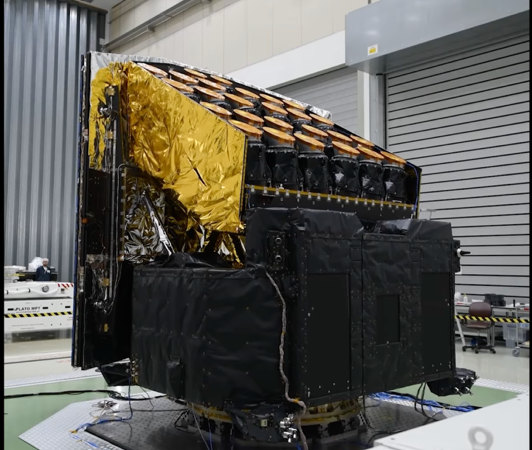
The PLATO satellite has successfully passed a first key stage of its testing campaign to verify that it is ready for launch. In ESA’s clean rooms at ESTEC, PLATO has successfully undergone an initial series of vibration tests, which consist of subjecting the satellite to intense vibrations in order to replicate the powerful shaking it will experience during its launch in January 2027, aboard an Ariane 6 rocket.
Watch the video of the vibration test here.
The stages of vibration testing
Vibration testing is organized into three parts :
- On a «quad » shaker, the satellite is shaken up and down (Z axis). This test is shown in the video.
- On a lateral shaker, the satellite is shaken back and forth sideways in two perpendicular directions (X and Y axes).
Each tests lasts one minute, during which the frequency of the oscillations gradually increases from 5 to 100 oscillations per second (hertz). At these higher frequencies, the movement is no longer visually perceptible, but it manifests itself in the form of a rumbling sound produced by the rapid vibrations of the satellite’s internal structure.
The first few minutes of a launch are the most difficult for a satellite, as it is subjected to extreme vibrations during lift-off. By subjecting PLATO to these stresses before the actual launch, engineers can ensure that no part of the satellite will be damaged during this critical stage.
Next steps for PLATO
Following the vibration tests, PLATO was placed in ESA’s acoustic test chamber, where it was subjected to deafening noise similar to what it will experience during lift-off. This test also went according to plan.The next step for PLATO is the Large Space Simulator, Europe’s largest vacuum chamber, where its resistance to extreme temperatures and emptiness of space will be verified.
PLATO at LAM
For the LAM team involved in PLATO, the success of these tests is an important step in preparing the satellite for launch and brings PLATO closer to its operational phase. This team of 20 people, led by Magali Deleuil (scientific manager) and Chrystel Moreau (LAM project manager), is actively involved in preparing the PLATO mission. The LAM team is present in the PLATO Science Management, the PLATO Data Centre, the Mission Steering Committee and Performance Support. The mission is expected to be ready for launch by the end of the year, with a departure aboard Ariane 6 scheduled for January 2027.
PLATO is the European Space Agency (ESA) mission to detect exoplanets, particularly terrestrial planets in the habitable zone of their star, using the planetary transit method, and to measure their parameters with the highest precision using asteroseismology of host stars and ground-based follow-up observations.