
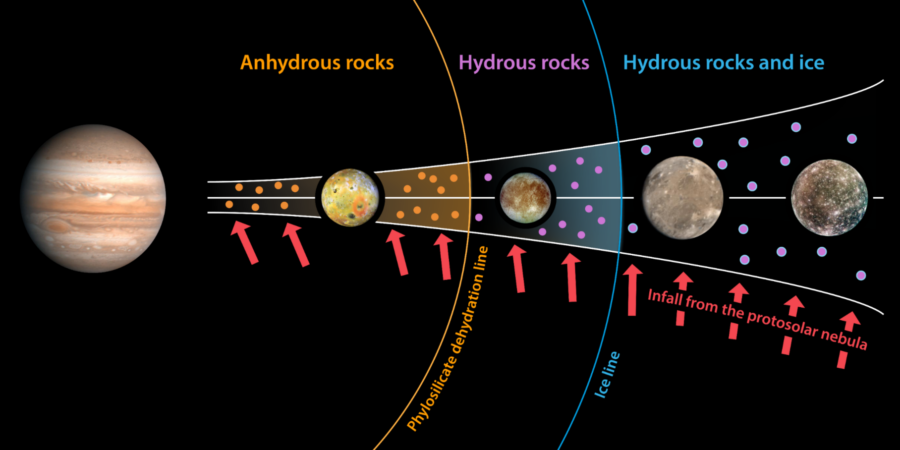
A new international study led by researchers at the Laboratoire d’Astrophysique de Marseille (LAM) shows that the most volcanic moon in the Solar System, Io, never contained water, whereas Europa has preserved its water reserves since its formation. These findings challenge the hypothesis of a late water loss on Io and shed light on the birth conditions of Jupiter’s Galilean satellites.
A Tale of Two Moons
Since the first exploratory missions to the Jovian system in the late 1970s, scientists have known that Jupiter’s moons exhibit starkly contrasting features. Among them, Io and Europa provide the most striking example: Io is a dry, intensely volcanic world, completely devoid of water, while Europa is rich in ice and may harbor a vast liquid ocean beneath its surface. How can such differences exist between two neighboring moons?
Key Findings
The study, published in The Astrophysical Journal, suggests that Io’s lack of water is not the result of a late loss but rather a consequence of its formation process. In contrast, Europa’s water reserves have been preserved since its birth, offering new insights into the early conditions of the Galilean satellites.
Reference: Yannis Bennacer et al. 2026, ApJ, 997, 70 DOI: 10.3847/1538-4357/ae2ebd
Read the full press release from Aix-Marseille Université and CNRS here.