
• Skip to primary navigation
  • Skip to main content
  • Skip to primary sidebar
  • Skip to footer
  • English
  • Français
    • Directory
    • Recruiting
    • Training

    LAM

    Logo Laboratoire d'astronomie de Marseille

    Laboratoire d’Astrophysique de Marseille

    • Laboratory
      • Presentation
      • Directory
      • Organization chart
      • General public
      • Practical information
      • Internal Links
    • Research
      • Galaxies, stars and cosmology
      • Optics & Instrumentation R&D Group
      • Planetary Systems
    • Services
      • Cryogenics and Space Qualification
      • Platform and Infrastructure Logistics
      • Mechanical
      • Optical
      • Quality management system
      • CeSAM: Marseille Astrophysical Data Center
    • Platforms
    • Data Centre
    • Projects
    • LAM Events

    The Galilean Moons Seen by PAPYRUS

    Jointly developed by the Laboratoire d’Astrophysique de Marseille (LAM) and ONERA, and installed at the Observatoire de Haute-Provence (OSU Institut Pythéas), PAPYRUS is a unique Adaptive Optics (AO) bench mounted on the 1.52-meter telescope (T152). Designed for on-sky validation of innovative Adaptive Optics concepts, it serves as a versatile platform dedicated to developing next-generation instrumentation for major observatories such as the VLT and the ELT.

    Since 2020, PAPYRUS has supported 10 PhD theses and fostered strong collaborations with leading institutions, including the Institut de Planétologie et d’Astrophysique de Grenoble (IPAG), the European Southern Observatory (ESO), INAF – Istituto Nazionale di Astrofisica, the University of Geneva, the University of Durham, NASA’s Jet Propulsion Laboratory (JPL), as well as industrial partners such as Bertin Alpao and Oxford Instruments Physics & Astronomy.

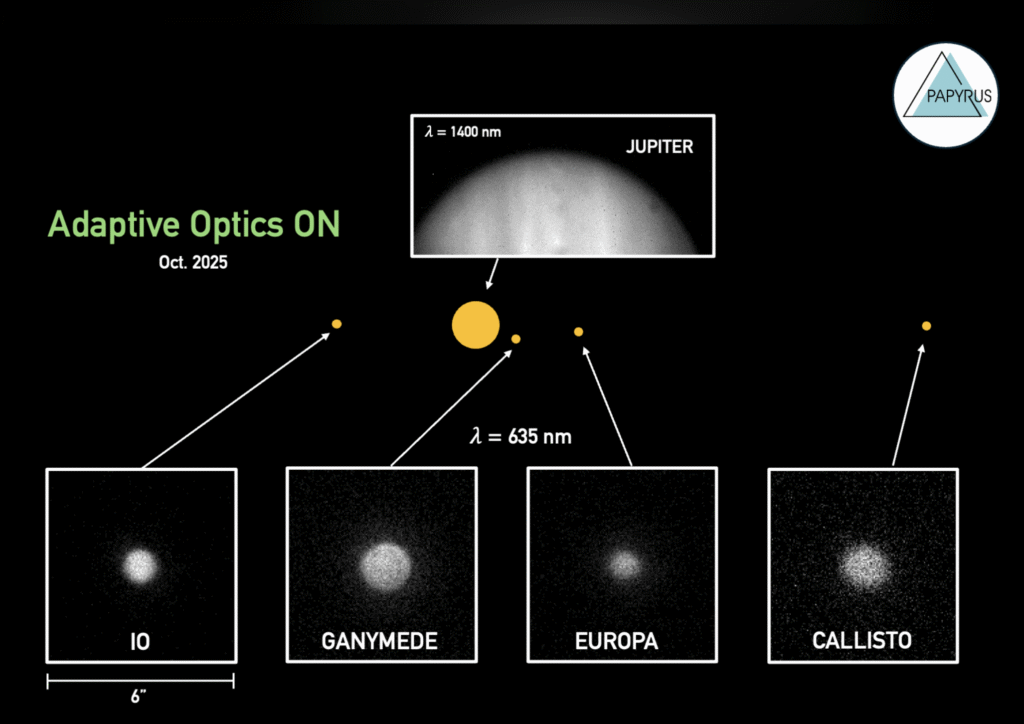
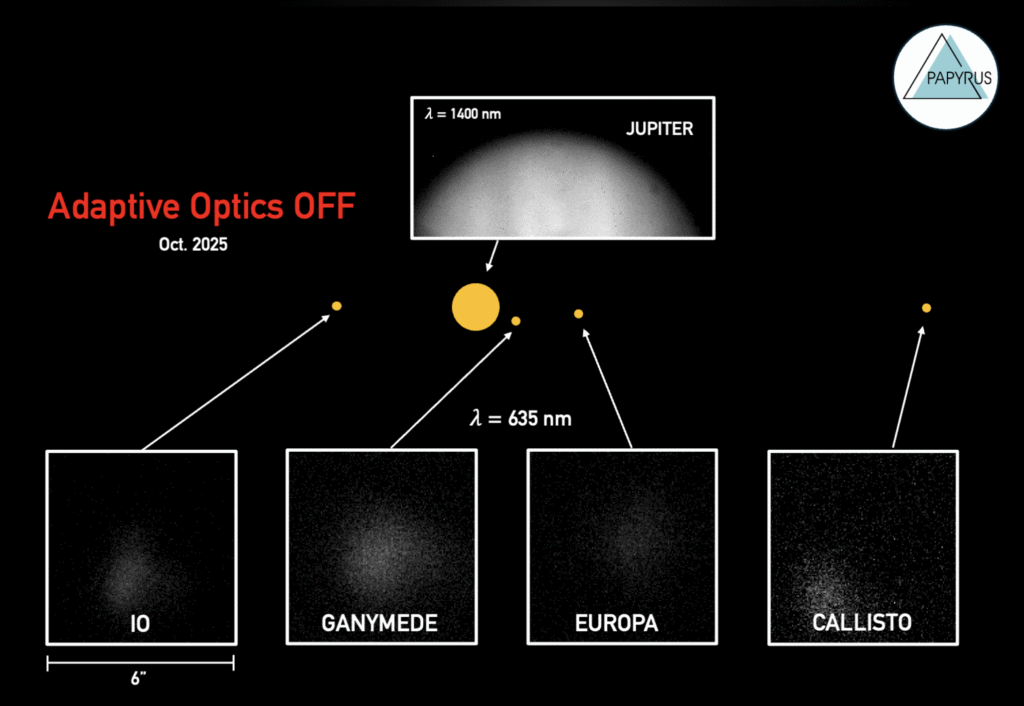
    Recently, PAPYRUS observed the Galilean moons: Io, Ganymede, Europa, and Callisto. The adaptive optics loop was successfully closed on each of them, enabling observations both in the visible and infrared domains.

    The images obtained are not only beautiful, they are also of significant scientific interest. PAPYRUS uses a pyramid wavefront sensor to measure distortions caused by atmospheric turbulence, and studying its performance on extended objects such as these moons remains an open question in adaptive optics. The analysis of this new dataset will represent an important step toward achieving high-resolution imaging of extended sources from the ground.

    Captures are below, and you can see the video clips there:

    • Jupiter and Ganymede: https://youtu.be/cDW6-h1brGM
    • The moons of Jupiter: https://youtu.be/vlzF37se4rk
    Primary Sidebar

    Categories

    • Asteroids
    • Aurora
    • Awards
    • Clusters of galaxies
    • Comet
    • Cosmology
    • Exo-planets
    • Galaxies
    • Instrumentation
    • Intergalactic environment
    • Laboratory Life
    • Massive stars
    • Non classé
    • Outreach
    • Prix
    • Solar system
    • Star formation
    • Sursauts Gamma
    • Vie du Laboratoire

    Footer

    Laboratoire d’Astrophysique de Marseille
    UMR7326
    Pôle de l’Étoile Site de Château-Gombert
    38, rue Frédéric Joliot-Curie
    13388 Marseille CEDEX 13 FRANCE
    Copyright © 2025

    Copyright © 2025 · Genesis Framework · WordPress · Log in

    • Site Map
    • Legal Notice
    • Privacy Policy
    • Credits
    • Internal Links
    Gérer le consentement aux cookies
    Pour offrir les meilleures expériences, nous utilisons des technologies telles que les cookies pour stocker et/ou accéder aux informations des appareils. Le fait de consentir à ces technologies nous permettra de traiter des données telles que le comportement de navigation ou les ID uniques sur ce site. Le fait de ne pas consentir ou de retirer son consentement peut avoir un effet négatif sur certaines caractéristiques et fonctions.
    Fonctionnel Always active
    Le stockage ou l’accès technique est strictement nécessaire dans la finalité d’intérêt légitime de permettre l’utilisation d’un service spécifique explicitement demandé par l’abonné ou l’utilisateur, ou dans le seul but d’effectuer la transmission d’une communication sur un réseau de communications électroniques.
    Préférences
    Le stockage ou l’accès technique est nécessaire dans la finalité d’intérêt légitime de stocker des préférences qui ne sont pas demandées par l’abonné ou l’utilisateur.
    Statistiques
    Le stockage ou l’accès technique qui est utilisé exclusivement à des fins statistiques. Le stockage ou l’accès technique qui est utilisé exclusivement dans des finalités statistiques anonymes. En l’absence d’une assignation à comparaître, d’une conformité volontaire de la part de votre fournisseur d’accès à internet ou d’enregistrements supplémentaires provenant d’une tierce partie, les informations stockées ou extraites à cette seule fin ne peuvent généralement pas être utilisées pour vous identifier.
    Marketing
    Le stockage ou l’accès technique est nécessaire pour créer des profils d’utilisateurs afin d’envoyer des publicités, ou pour suivre l’utilisateur sur un site web ou sur plusieurs sites web ayant des finalités marketing similaires.
    Manage options Manage services Manage {vendor_count} vendors Read more about these purposes
    Voir les préférences
    {title} {title} {title}