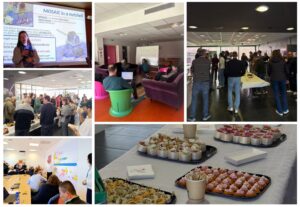
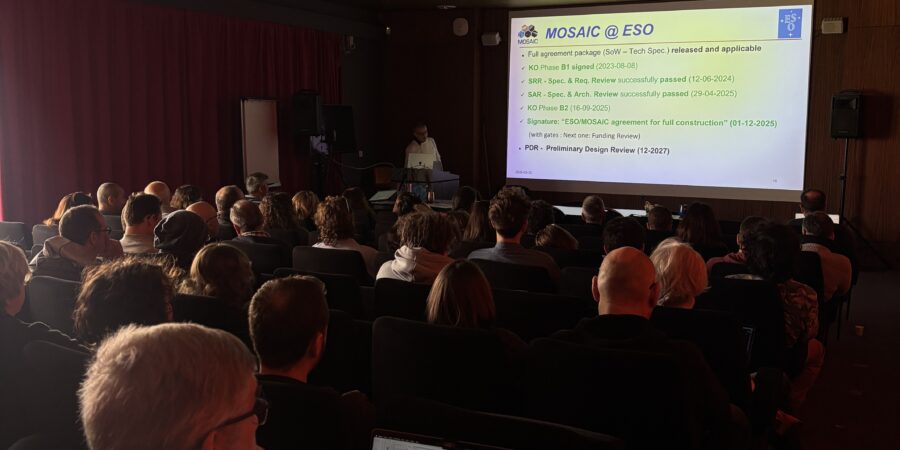
The “ELT: Made in LAM!” event, held at the laboratory on Monday, March 30, brought together many members of LAM to discuss the scientific and instrumental challenges of the future Extremely Large Telescope.
The morning began with an introductory talk by Nicolas Laporte, who reviewed the history of the ELT project, the progress of the telescope—particularly its mirrors—and reminded attendees that the first technical light is expected in March 2029.
This introduction was followed by presentations dedicated to the major instruments led by LAM: MOSAIC, presented by Roser Pellò (PI), and HARMONI, by Benoît Neichel (co-PI), who highlighted their unique capabilities and transformative potential for astronomy in the coming decades. Isabelle Boisse and Arthur Vigan then presented the ANDES and PCS instruments, respectively, emphasizing their crucial role in the study of exoplanets and the search for signs of life, while cautiously noting that the detection of biomarkers does not in itself constitute irrefutable proof of life.
Finally, two more technical talks by Kacem El Hadi and Anne Costille illustrated the decisive involvement of LAM teams in the development of the MOSAIC and HARMONI instruments.
The afternoon was devoted to two in-depth scientific workshops, highlighting the potential synergies between the “Made in LAM!” instruments, led by Olivier Groussin and Nicolas Laporte, and the laboratory’s strategic position in leading and structuring cutting-edge scientific themes in the ELT era.
A workshop dedicated to instrumentation, led by Cristian Surace and Zalpha Challita, clarified the technical involvement of LAM teams and services throughout the design, assembly, and verification phases of the two instruments, and identified associated process synergies and optimizations.